2025 Tax Prep in California: Key Deadlines + New OBBBA Tax-Saving Opportunities (LA & San Diego)
February 9th, 2026
Tax season moves fast—especially for California taxpayers who juggle W-2 income, self-employment, real estate, and multiple entities. The IRS opened the 2026 filing season on Monday, January 26, 2026, which means it’s time to start organizing your documents and planning for the new tax changes that impact 2025 returns.
This blog highlights the most important 2026 filing deadlines, plus a plain-English overview of major One Big Beautiful Bill Act (OBBBA) provisions that can create immediate tax planning opportunities for 2025.
2026 tax deadlines for 2025 returns
Here are the deadlines most California individuals and business owners should have on their radar:
March 16, 2026 — S-Corps & Partnerships (calendar-year filers)
S-Corporations (Form 1120-S) and Partnerships (Form 1065) are generally due the 15th day of the 3rd month after year-end (March 15). Because March 15, 2026 falls on a Sunday, the deadline shifts to Monday, March 16, 2026 under the IRS weekend/holiday rule.
Extensions: A 6-month extension is generally available (commonly via Form 7004 for these entity returns).
April 15, 2026 — Individual returns & many business filings
Most individual returns (Form 1040) are due the 15th day of the 4th month after year-end (April 15 for calendar-year filers).
Extensions: Individuals typically use Form 4868 for an automatic 6-month extension to file (note: an extension to file is not an extension to pay).
If you’re not sure whether you’ll owe, it’s smart to estimate early so you can plan payments and avoid late-payment penalties/interest.
Big OBBBA changes that can affect your 2025 tax return
The IRS has published summaries of key OBBBA provisions for individuals, including new above-the-line deductions and inflation-adjusted standard deductions.
1) Higher 2025 standard deduction (even if you don’t itemize)
For tax year 2025, the IRS lists these standard deductions:
- Married filing jointly: $31,500
- Head of household: $23,625
- Single / married filing separately: $15,750
2) “Enhanced deduction for seniors” (age 65+), 2025–2028
Beginning in 2025, eligible taxpayers age 65+ may qualify for an additional deduction of up to $6,000 per eligible person (with phaseouts based on modified adjusted gross income).
3) “No tax on tips” deduction (2025–2028)
Eligible employees and self-employed individuals may be able to deduct qualified tips, up to $25,000, with income-based phaseouts and specific reporting requirements.
4) “No tax on overtime” deduction (2025–2028)
Eligible individuals may deduct the portion of overtime pay that exceeds the regular rate (example: the “half” part of time-and-a-half), up to $12,500 ($25,000 joint), subject to income-based phaseouts and reporting requirements.
5) “No tax on car loan interest” deduction (2025–2028)
Eligible individuals may be able to deduct interest paid on a qualified vehicle loan for personal use (leases don’t qualify), up to $10,000, with income-based phaseouts and vehicle eligibility rules (including final assembly in the U.S. and GVWR under 14,000 lbs).
The SALT cap increase: a major planning opportunity for many Californians
If you itemize deductions, the state and local tax (SALT) deduction limit is now $40,000 for 2025 ($20,000 if married filing separately), with reductions starting at higher MAGI—but generally not reduced below $10,000 ($5,000 MFS).
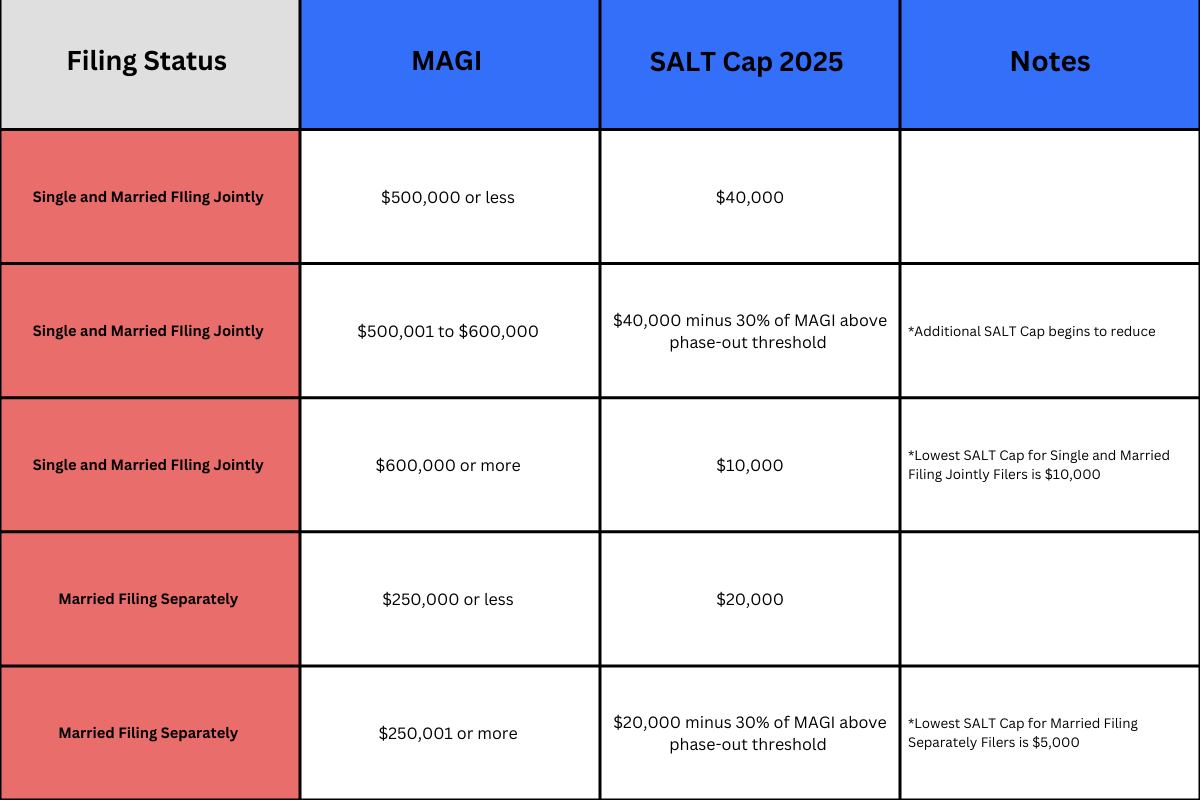
What this means in practice
- More California taxpayers may benefit from itemizing again (especially those with higher property taxes and/or state income taxes).
- If you’re near the MAGI thresholds, planning may involve:
- Timing deductible expenses where allowed
- Reviewing entity structure and compensation strategies
- Coordinating charitable giving documentation (cash + noncash)
Business owners: don’t miss 2025 deduction opportunities
100% bonus depreciation restored (for eligible property acquired after Jan. 19, 2025)
The IRS notes that 100% “additional first-year depreciation” (bonus depreciation) was restored for eligible property acquired after January 19, 2025, with related IRS guidance available.
This can matter for business equipment and certain assets placed in service in 2025.
Family on payroll: helpful strategy, but documentation matters
Employing family members can create legitimate tax advantages when done correctly—but the IRS expects wages to be:
- For real, age-appropriate work
- Reasonable for the role
- Properly documented (time logs, job descriptions, payroll records)
If you’re considering children or parents on payroll, TaxPlus can help you set it up compliantly and integrate it into your broader tax plan.
Local compliance note for Los Angeles businesses
Many LA-based businesses, freelancers, and self-employed taxpayers also track the City of Los Angeles annual business registration renewal (often a late-February milestone). If you operate in LA, plan early so you don’t miss local compliance steps that may affect exemptions or penalties.
Start your 2025 tax preparation with TaxPlus
TaxPlus supports individuals and businesses across California—with a focus on Los Angeles and San Diego—for:
- Tax preparation
- Tax planning
- Resolution and representation
- Ongoing accounting support
Fast next step
- If you expect an entity filing (S-Corp/Partnership), start now so K-1s and supporting schedules are ready ahead of March 16, 2026.
- If you’re filing an extension, remember: extensions give more time to file, not necessarily more time to pay.
Los Angeles: 310.398.3231
San Diego: 858.279.1640
FAQ
When can I start filing my 2025 taxes?
The IRS opened the 2026 filing season on January 26, 2026, which is when taxpayers can begin filing 2025 federal returns.
Why is the S-Corp/Partnership deadline March 16, 2026 (not March 15)?
Those returns are generally due March 15, but when a due date falls on a weekend or legal holiday, the IRS treats it as timely if filed the next business day—so the deadline moves to March 16, 2026.
What is the SALT cap for 2025?
For many filers who itemize, the SALT deduction limit is $40,000 for 2025 ($20,000 if married filing separately), with reductions tied to MAGI.
Get Started On 2025 Tax Filings
We will be working extended hours to deliver accurate and timely filings. Please reach out to May@taxplus.com in L.A. at 310.398.3231 or to Henna@taxplus.com in S.D. at 858.279.1640 to start the tax filing process. We can work with you effectively in person or virtually.
***If you are a returning client for 2025 tax filings, please feel free to request a customized 2025 tax organizer for review. These organizers include the previous year’s information for reference.
Disclaimer: This content is for general informational purposes and is not legal or tax advice. Tax rules can be complex and vary by individual circumstances—consult one of our qualified tax professionals for guidance specific to your situation. Contact us here.
.png)