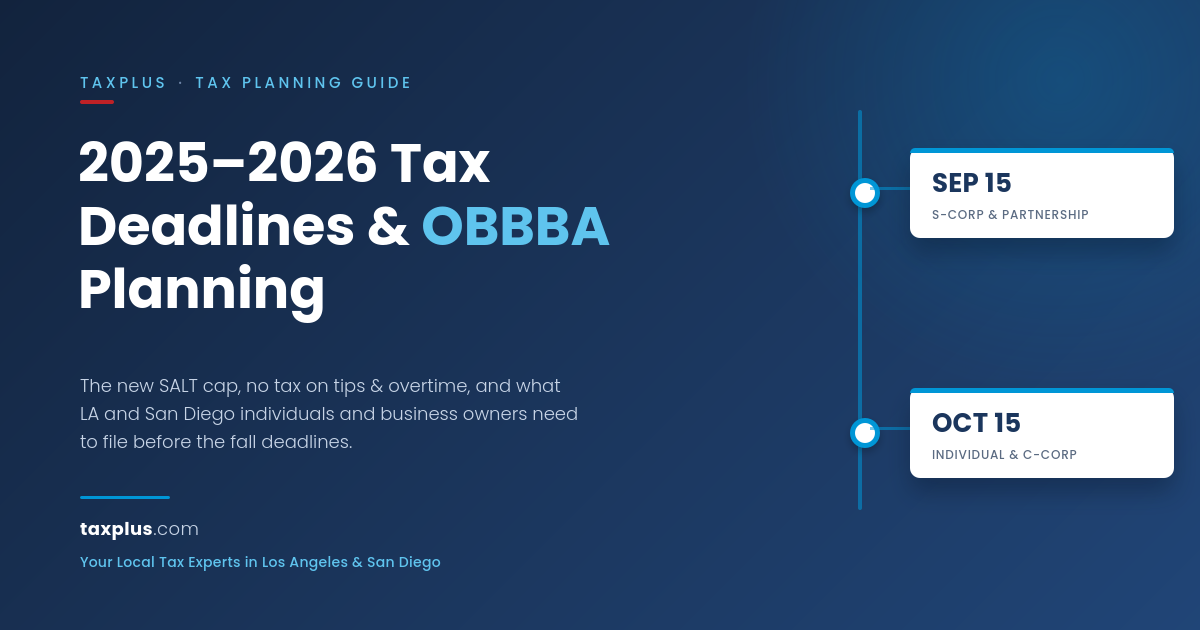
2025–2026 Tax Deadlines & OBBBA Tax Planning Guide: What Every Taxpayer and Business Owner Needs to Know
August 25th, 2026
2025–2026 Tax Deadlines & OBBBA Tax Planning Guide: What Every Taxpayer and Business Owner Needs to Know
Published by TaxPlus | Los Angeles & San Diego
Late summer means back-to-school shopping, Halloween candy on the shelves — and important tax deadlines on the horizon. It’s also the first tax season shaped by the One Big Beautiful Bill Act (OBBBA), which introduces some of the most significant tax changes in years, including a dramatically higher SALT deduction cap.
This guide covers everything you need to know: upcoming deadlines, estimated tax payments, and the new deductions and planning strategies available to individuals and business owners.
Upcoming Tax Deadlines
September 15 — S-Corporation and Partnership Deadline (Extended Returns)
S corporation (Form 1120S) and partnership (Form 1065) returns for calendar-year entities were originally due March 15. If you filed a timely extension, you received six additional months — making September 15 your final deadline. Extensions are no longer available; returns filed after this date may face late-filing penalties.
October 15 — Individual, Single-Member LLC, and C-Corporation Deadline (Extended Returns)
Individual (Form 1040) returns, Single-Member LLC returns (Form 568, for entities not owned by a pass-through entity), and C-Corporation returns (Form 1120) were originally due April 15. A timely extension pushed the filing deadline to October 15. Keep in mind: an extension to file is not an extension to pay — if estimated payments weren’t made with the extension, late-payment penalties may apply.
September 15 — Third Quarter Estimated Tax Payments
Self-employed individuals, independent contractors, and small business owners should submit their Q3 2026 federal (and possibly state) estimated tax payments by September 15. If you’re profitable and self-employed, pre-paying taxes quarterly helps you avoid underpayment penalties. Our team can help calculate your specific federal and state estimated payment amounts.
How to Start Your 2025 Tax Preparation
Whether you’re a new or returning client:
- Call our office — Los Angeles: 310-398-3231 or San Diego: 858-279-1640
- Our front desk connects you with an associate for guidance tailored to your situation
- You’ll receive instructions, organizers, and a secure document upload link
- Your associate prepares a 2025 Tax Draft and answers questions throughout
- A Final Review conference is coordinated with a senior reviewer
Returning clients can request a customized 2025 tax organizer pre-filled with prior-year information for easy reference.
OBBBA Tax Savings: The Big Changes for 2025
The One Big Beautiful Bill Act (OBBBA) introduces sweeping changes, most phased in over several years. Here are the immediate impacts for 2025 filings.
SALT Deduction Cap Increase — The Headline Change
The State and Local Tax (SALT) deduction cap has been temporarily raised from $10,000 to $40,000, in effect through 2029 (increasing 1% annually until then, and reverting to $10,000 in 2030). This is especially valuable if you live in a high-income-tax state (CA, NY, HI, VT, ME) or a high-property-tax state (IL, NJ, CT, NE, VT, NH, TX).
The higher cap is subject to income-based phase-outs based on Modified Adjusted Gross Income (MAGI):
| Filing Status | MAGI | 2025 SALT Cap |
|---|---|---|
| Single / Married Filing Jointly | $500,000 or less | $40,000 |
| Single / Married Filing Jointly | $500,001–$600,000 | $40,000 minus 30% of MAGI above $500,000 (phase-out range) |
| Single / Married Filing Jointly | $600,000 or more | $10,000 |
| Married Filing Separately | $250,000 or less | $20,000 |
| Married Filing Separately | $250,001 or more | $20,000 minus 30% of MAGI above $250,000 (floor: $5,000) |
Planning tip: If you’ll benefit from the new SALT cap, consider adjusting your federal withholdings for 2026 (through 2029, before the cap reverts) to increase your take-home pay rather than waiting for a refund. If you expect to itemize, start tracking monetary and in-kind charitable contributions now, since they factor directly into your itemized deduction calculation.
No Tax on Overtime (2025–2028)
Eligible filers can deduct up to $12,500 ($25,000 for Married Filing Jointly) of overtime compensation from gross income per year. This is an above-the-line deduction, available in addition to the standard or itemized deduction.
- Income limit: MAGI of $150,000 ($300,000 MFJ) or lower
- What qualifies: Only the additional portion of overtime pay — e.g., if your regular rate is $40/hour and overtime pays $60/hour, only the extra $20/hour qualifies
- Proof of overtime compensation is required to claim this deduction
No Tax on Tips (2025–2028)
Employees and self-employed individuals can deduct up to $25,000 in tip income from gross income per year, as an above-the-line deduction.
- Income limit: MAGI of $150,000 ($300,000 MFJ) or lower
- Tips must come from an occupation that customarily and regularly receives them
- Note: states may still tax tip income even though it’s exempt federally
No Tax on Car Loan Interest (2025–2028)
You may deduct up to $10,000 per year in car loan interest as an above-the-line deduction, if:
- The vehicle is new (not used)
- Purchased during the year for personal use
- Has final assembly in the U.S.
- Weighs under 14,000 pounds
- Your MAGI is $100,000 or less ($200,000 MFJ) for the maximum deduction
Charitable Deductions Matter More Now
With more taxpayers likely to itemize thanks to the higher SALT cap, both cash and non-cash (in-kind) charitable contributions become more valuable — directly reducing taxable income. Start keeping detailed records now.
Strategic Planning to Maximize the SALT Cap Benefit
If your projected 2025 MAGI puts you at risk of losing part or all of the increased SALT deduction, there are ways to plan ahead:
Consider an S-Corp or Side Business
Reporting business deductions through a side business — sole proprietorship, DBA, or S-Corporation — can help offset other income, including W-2 wages, lowering your MAGI. Forming an S-Corp specifically may offer added benefits: personal asset protection and reduced self-employment taxes once the business is profitable.
Maximize Retirement Contributions
Contributing more to deductible retirement plans lowers MAGI. If you have a business, you may be able to set up a deductible retirement plan and contribute retroactively for 2025. Traditional IRA contributions can be made through April 15, 2026 and still count toward reducing 2025 taxable income (subject to income limits).
Higher 2025 Standard Deductions
If itemizing doesn’t make sense for you, the standard deduction has increased:
- Married Filing Jointly: $31,500 (up $2,300 from 2024)
- Single / Married Filing Separately: $15,750 (up $1,150 from 2024)
- Head of Household: $23,625 (up $1,725 from 2024)
- Additional $2,000 for taxpayers age 65+ or blind
New “Senior Bonus” Deduction (2025–2028)
OBBBA introduces a temporary deduction of up to $6,000 per qualifying senior (65+), available whether you itemize or take the standard deduction.
Eligibility:
- Must be 65 or older by year-end (each spouse can qualify separately if filing jointly)
- Single filers: Full $6,000 deduction available up to $75,000 MAGI; phases out completely at $175,000 MAGI
- Married Filing Jointly: Full $12,000 deduction (both spouses qualifying) available up to $150,000 combined MAGI; phases out completely at $250,000 MAGI
Other Key OBBBA Changes for 2025
- Electric Vehicle Tax Credit: Repealed — the full EV credit ended September 30, 2025. The used-EV credit remains available until June 2026.
- Residential Energy Credits: Ended December 31, 2025 (existing carryforwards are unaffected).
- Bonus Depreciation: Restored to 100% for qualified business property (including qualifying vehicles) placed in service on or after January 19, 2025.
- Child Tax Credit: Increased from $2,000 to $2,200 per child for 2025, with inflation adjustments beginning in 2026.
Year-End Tax Planning for Business Owners (2026)
- Equipment Purchases: Business equipment purchased in 2026 will likely qualify for a 100% deduction. Financing by 12/31/26 still qualifies. If you paid for a business purchase on a personal card, reimburse yourself by 12/31/25.
- Qualified Improvement Property: Interior improvements to non-residential commercial property may be immediately deductible for 2026 if placed in service by 12/31/26.
Family Employment Strategies
Hiring Your Children
Putting your children on payroll offers a dual benefit:
- Income shifting — Wages paid to your child are a deductible business expense, shifting income from your higher tax bracket to your child’s much lower one (potentially 0%)
- Reduced payroll tax burden — Children under 21 are exempt from Social Security, Medicare, and FUTA withholding (income tax withholding still applies)
Your child can also begin building retirement savings early, since IRA and 401(k) contributions require “earned income” — something most kids don’t have access to otherwise. Employer retirement plan contributions made on your child’s behalf may also be deductible business expenses. Note: the work must be legitimate and age-appropriate.
Entertainment industry families: If your child works in entertainment, a Coogan account is legally required to protect a portion of their earnings until adulthood.
Hiring Other Family Members
While the tax advantage is smaller than hiring a child, employing a parent or other family member still offers benefits:
- No FUTA withholding requirement for parents on payroll
- Income-shifting to a lower tax bracket
- Family members earn Social Security credits and can contribute to retirement plans through their wages
Ready to Start Your 2025 Tax Filing?
Our team is working extended hours to deliver accurate, timely filings — in person or virtually.
Los Angeles Office 📞 310-398-3231 ✉️ May@taxplus.com
San Diego Office 📞 858-279-1640 ✉️ Ashley@taxplus.com
Call now to begin your 2025 tax preparation process, or reach out to schedule a phone or video conference with one of our Enrolled Agents.
This article is for general informational purposes based on current OBBBA provisions and is not individualized tax advice. Contact TaxPlus to discuss how these changes apply to your specific situation.
.png)